Obituary: Joan Witek (1943-2026)
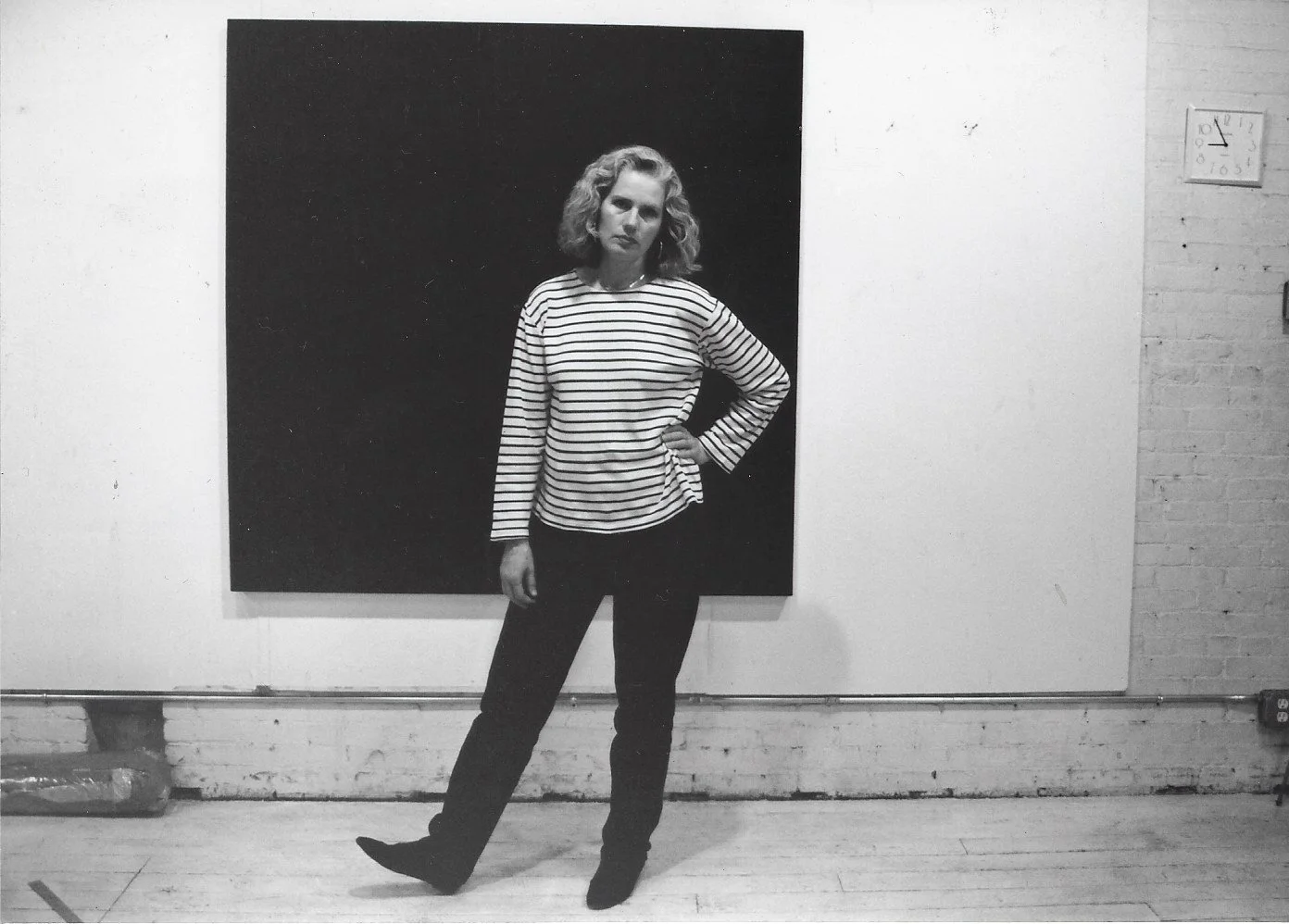
Joan Witek in her Duane Street studio, 1996. Photo: Virginia Crespo
Joan Witek, Painter and Curator Who Found Infinite Life in Black, Dies at 83
Joan Witek, a painter of singular vision and a respected curator whose institutional work helped shape the American understanding of Pre-Columbian and New Guinean art, died on June 6, 2026. She was 83. Her death is confirmed by Artist Estate Studio, LLC, the entity that has been involved in her studio since 2000.
Born in New York City in 1943, Witek came of age as both a maker and a curator of art — roles she held in productive tension for much of her life. She earned her BFA from Hofstra University in 1964 where her teachers were Ralston Crawford and Pearl Fine. She continued her training at the Brooklyn Museum Art School and, later, the Art Students League studying with Morris Kantor. It was during those years of study that she also began her curatorial life, serving first at the Jewish Museum in New York before moving to the Brooklyn Museum, where she worked as a Curatorial Assistant in the department of Art of the Americas from 1964 to 1968. During this time, she traveled extensively including Europe, Turkey, and three trips to Mexico. Her curatorial work was exacting and immersive — researching, installing, publishing, and lecturing on the art of peoples whose visual languages were among the most formally complex in the world.
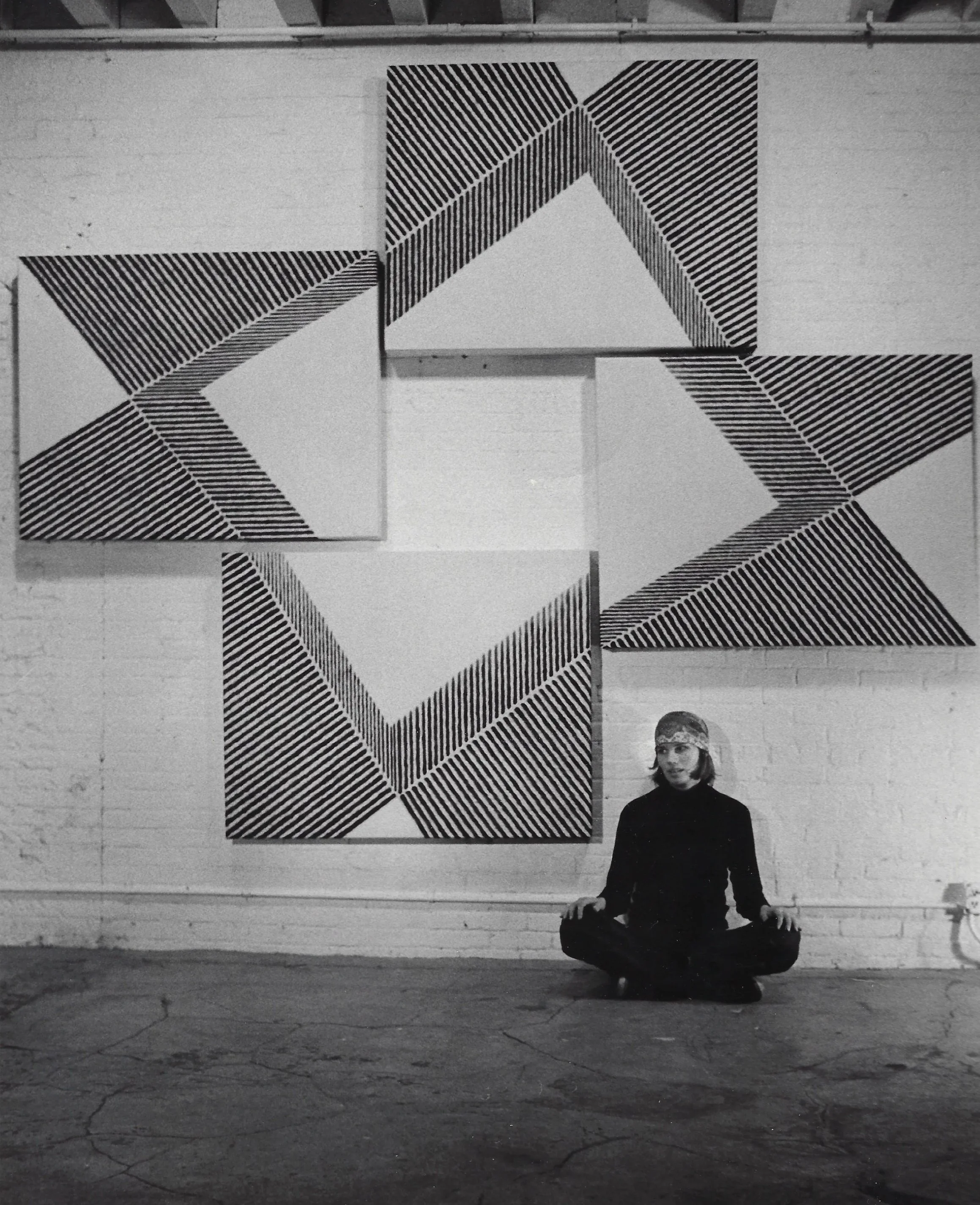
Joan Witek in her Duane Street Studio, 1974. Photographer unknown
In 1969, she enrolled at the Art Students League of New York, where she began to paint seriously. Simultaneously, she returned to museum work, joining the Metropolitan Museum of Art as Assistant Curator in the Department of the Arts of Africa, Oceania, and the Americas, a position she would hold until 1978. In 1975, she curated and authored the text for the exhibition Mochica, Paracas, and Nazca: One Thousand Years of Ancient Peruvian Ceramics for the Queens Museum. Her years at the Met coincided with the development of what would become the Rockefeller Wing, and she devoted herself to the research and installation of Pre-Columbian and New Guinean art with the same rigor she brought to her canvases.
In 1973 she stopped her formal studies at the League, and with a grant from the Lowe Foundation (juried by Louise Nevelson), she sublet a studio on Canal Street. By 1976 she had established her own space in Lower Manhattan — a Duane Street loft that would become a fixture of the downtown New York art world with neighbors that included Elizabeth Murray and Richard Serra. In 1978, she made the decision that would define the rest of her life: she left her curatorial work entirely and gave herself over to painting.
What followed was a career of rare consistency and depth. Witek's early work had been vigorously representational — a series of portraits, figures in chairs, furniture rendered with adventurous color and slightly distorted form. Gradually the subjects fell away, replaced by abstraction. By 1974 she had arrived at what would become her lifelong commitment: a large four-canvas work composed and painted solely using the color black. It was her first work concerned exclusively with simple geometric form, and her first to use the color that would define everything that followed.
For the remaining five decades of her career, Witek probed what she called the infinite variety of black — not black as absence or negation, but as a living chromatic field of complexity and meaning. "It is sophisticated and primitive," she said, "emotional and intellectual — a color that everyone responds strongly to, in one way or another." Working primarily in oil stick and graphite on canvas and paper, she produced paintings that moved between matte and gloss, density and light, restraint and intensity. As the critic Lily Wei wrote of her work in 2000, Witek played "black being ascetic and alluring, meditative and expressive, flawless and flawed, fierce and demure, a distinct unequivocal presence, yet subtle, elusive." Her canvases held that paradox without resolving it, rewarding close and patient looking.
A key presence in the downtown New York art world since the 1970s — alongside dominant figures such as Ellsworth Kelly, Frank Stella, and her neighbor Richard Serra — Witek was never easy to categorize. Her work touched minimalism without fully belonging to it, and while she shared a formal language with those dominant figures, she parted ways with them on the question of expression. Whereas Stella famously insisted that "what you see is what you see," Witek had always allowed feeling inside the frame, going so far as to call her paintings self-portraits.
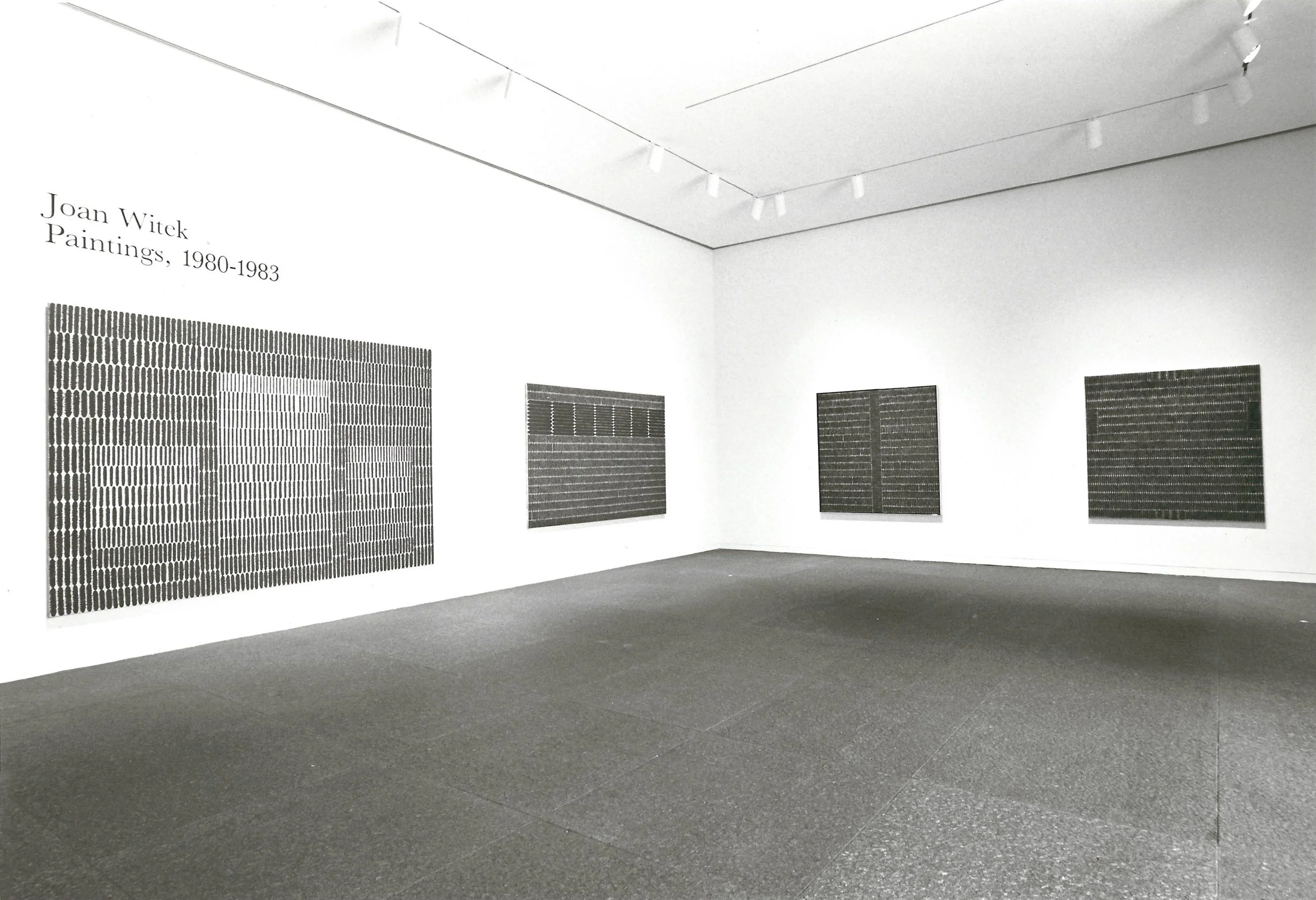
Installation view: “Joan Witek: Paintings, 1980-1983,” Museum of Art, Carnegie Institute, Pittsburgh, PA, March 3-April 29.
Witek’s first solo exhibition after graduating from Hofstra was held at the Ames Gallery in 1975 and featured works playing with the simple theme of the square. Nearly a decade later, in 1984, the Museum of Art at Carnegie Institute in Pittsburgh mounted Joan Witek: Paintings, 1980–1983 and Joan Witek: Drawings, 1976–1984 — her first museum one-artist exhibition. Organized by curator John Caldwell, the dual exhibition marked a decisive moment of institutional recognition, situating her work in direct dialogue with the major figures of American minimalism while making clear that she had extended and, in certain respects, openly critiqued their legacy. On the occasion of the show, the Carnegie Museum acquired her large 1983 canvas Equivalent for its permanent collection.
She would continue to exhibit regularly in New York City with solo exhibitions at the Rosa Esman Gallery, John Davis Gallery, CDS Gallery, Kouros Gallery, Jason McCoy Gallery, and Massey Klein. In March 2020, a mini-survey of important paintings from the 1980s opened just days before the COVID lockdown at Minus Space in Brooklyn. In Europe, she began exhibiting with Niklas von Bartha in London in the early 2000s. Bartha connected her work with European collectors including Carl-Jügen Schroth. Schroth presented a survey of her work at his private museum Museum Wilhelm Morgner in Soest, Germany in 2021. Other notable collectors include Wynn Kramarsky, who built his collection around Witek’s works on paper and presented several solo exhibitions at his gallery at 560 Broadway. Kramarksy subsequently donated many works to museums throughout the United States.
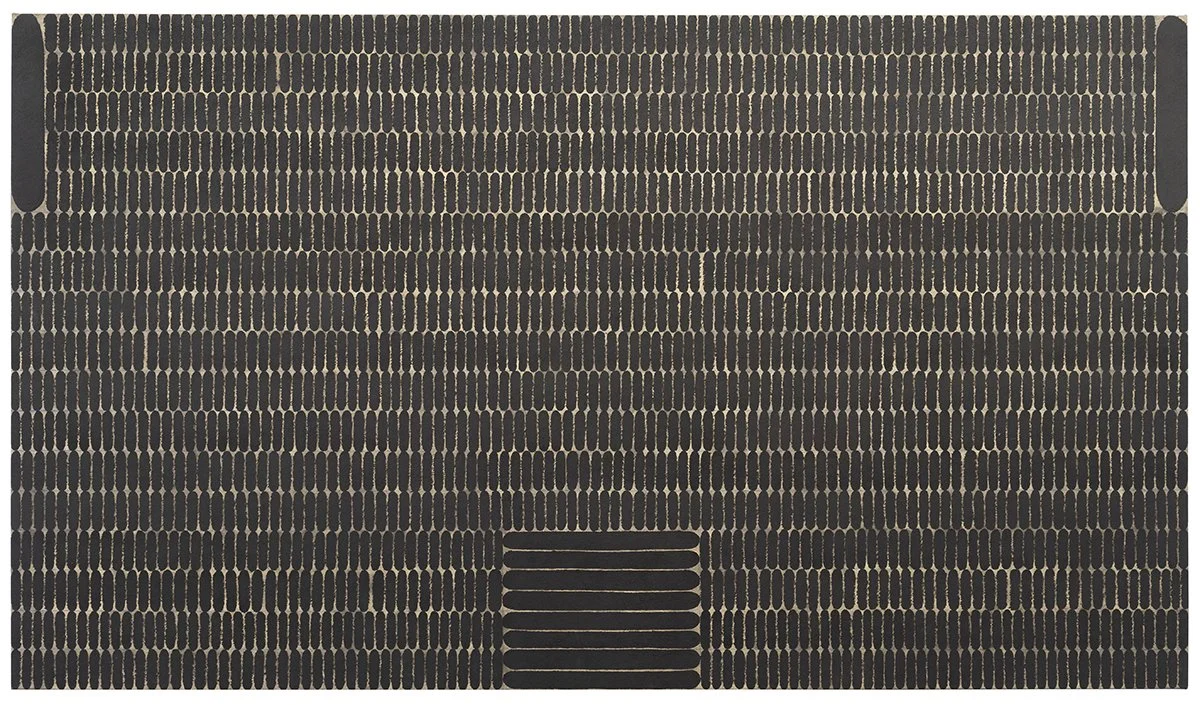
“Edward Teller’s Dream [P(S)-012],” 1982, oil stick and graphite on canvas, 68 × 110 in (172.7 × 279.4 cm) Nelson-Atkins Museum of Art, Kansas City, Missouri (2025.7)
Other early supporters were the curator Lawrence Alloway who featured her work in Women Artist From New York in 1978 at the Art Gallery at SUNY Stony Brook. The exhibition also included work by Shirely Gorelick, Rosemary Mayer, Joan Semmel, Sylvia Sleigh, and Nancy Spero, among others. Another early supporter was the museum director William Lieberman who, in 1980, facilitated the acquisition of Witek’s painting Split (1978) for the Metropolitan Museum of Art. This painting would be the first of many institutional acquisitions. Last year, in the fall of 2025, a survey of works spanning from 1969 to 2012 opened at Hunter Dunbar Projects in New York. It would be Witek’s final major exhibition during her lifetime.
Witek’s painting can be found in the permanent collections of the Museum of Modern Art, the Metropolitan Museum of Art, the San Francisco Museum of Modern Art, The Baltimore Museum of Art, the Carnegie Museum of Art, the Albright-Knox Art Gallery, the Fogg Art Museum at Harvard, The Nelson-Atkins Museum of Art, the Yale University Art Gallery, and the Arkansas Arts Center, and most recently, the Allentown Art Museum among others.
She is survived by her husband Jonathan Kandell, whom she married in April 1989, and her sister Virginia Crespo.